


Chim Cheroo Chimney Service: Chimney Masonry Repair in Huron, OH
Huron, OH offers some of the most beautiful lakefront views in the region, but that same proximity to Lake Erie means our homes endure intense weather patterns. At Chim Cheroo Chimney Service, we understand that maintaining a home in this climate requires vigilance and high quality maintenance. Our team specializes in chimney masonry repair, ensuring that the brick and mortar structures of your home can withstand the freeze thaw cycles, high winds, and heavy precipitation typical of Northern Ohio. We approach every project with a focus on longevity and structural integrity. When you work with us, you are hiring a team dedicated to keeping your heating system operating as efficiently as possible while preserving the aesthetic value of your property.
Does Freeze/Thaw Weathering Accelerate Deterioration in Colder Climates, and How Can Waterproofing Slow It Down?
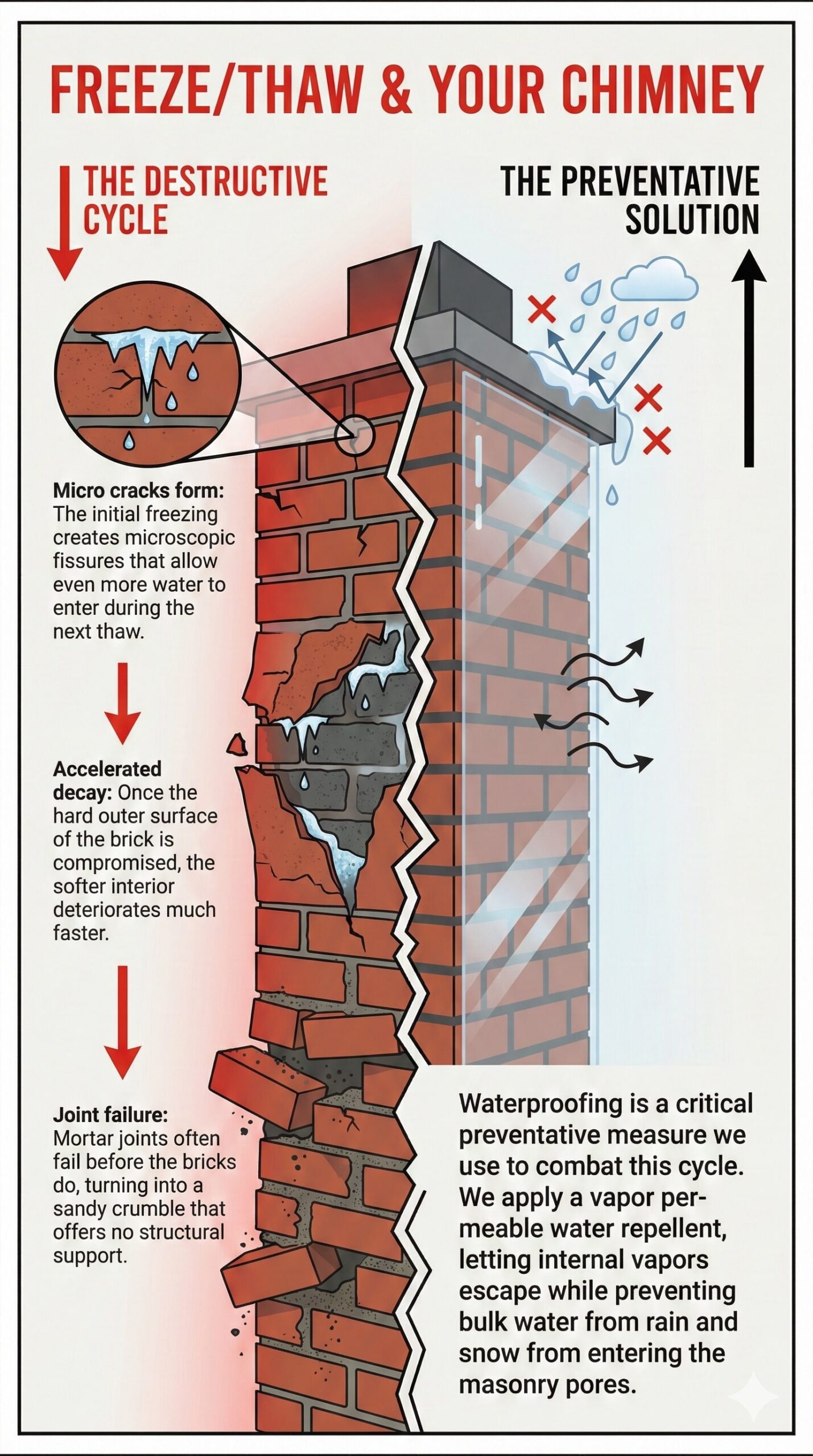
Living in Huron means dealing with wet autumns followed by freezing winters, a combination that creates the perfect environment for freeze thaw weathering. This natural process is one of the primary enemies of masonry chimneys. Bricks and mortar are porous materials, meaning they naturally absorb moisture from rain, snow melt, and humidity. When the temperature drops below freezing, the water trapped inside the tiny pores of the masonry expands by approximately nine percent.
This expansion creates significant internal pressure within the brickwork. Over time, this repeated cycle causes the face of the brick to pop off or flake away, a condition known as spalling. If left unaddressed, the structural core of the chimney can eventually degrade, leading to costly rebuilds.
- Micro cracks form: The initial freezing creates microscopic fissures that allow even more water to enter during the next thaw.
- Accelerated decay: Once the hard outer surface of the brick is compromised, the softer interior deteriorates much faster.
- Joint failure: Mortar joints often fail before the bricks do, turning into a sandy crumble that offers no structural support.
Waterproofing is a critical preventative measure we use to combat this cycle. However, it is important to note that this is not about sealing the chimney with a non breathable coating like paint or tar, which can actually trap moisture inside and accelerate rot. Instead, we apply a vapor permeable water repellent.
This specialized treatment allows the chimney to “breathe,” letting internal vapors escape while preventing bulk water from rain and snow from entering the masonry pores. By keeping the masonry drier, we significantly reduce the volume of water available to freeze and expand. While waterproofing cannot fix bricks that are already spalling, applying it to repaired or new masonry is the most effective way to extend the lifespan of the repair and reduce the risk of future freeze thaw damage.
Discovering Huron, OH: A Lakefront Gem
Huron, OH is more than just a place where we work; it is a community with a distinct rhythm defined by Lake Erie. Residents and visitors alike are drawn to the iconic Huron Pier and Lighthouse. Walking the pier at sunset offers some of the most spectacular views on the Great Lakes, providing a peaceful escape from the daily grind. The area is a haven for nature lovers, boasting the Sheldon Marsh State Nature Preserve, which attracts birdwatchers from all over during migration seasons.
During the warmer months, Nickel Plate Beach becomes a hub of activity with its soft sands and volleyball courts, while the boat basins fill with activity. We love serving this area because of the pride residents take in their properties. Whether it is a historic home near the water or a newer construction further inland, the people of Huron value community and quality. At Chim Cheroo Chimney Service, we aim to match that local pride with workmanship that honors the character of the neighborhood.
How Fast Can Crumbling Mortar Compromise a Chimney’s Stability? Could It Really Collapse in Just One Season?
Homeowners often ask us if a chimney can go from looking “okay” to being structurally unsound in a single year. While a sudden, total collapse is rare without an external force like a falling tree, the structural integrity of a chimney can degrade much faster than people realize, especially once the mortar begins to crumble. We refer to this crumbling mortar as “punky.” When mortar loses its binding properties, the bricks are essentially just stacked on top of one another, held in place only by gravity and friction rather than a solid bond.
The timeline for deterioration accelerates rapidly once the initial decay sets in. It might take twenty years for the first crack to appear, but once water begins penetrating that crack, significant structural loss can occur within just a few seasons.
- Wind loading: A chimney with crumbling mortar loses its tensile strength. During a heavy storm, the wind pressure can shift loose bricks, creating a dangerous lean.
- Water washout: Heavy rains can wash the sand out of degraded mortar joints, leaving visible gaps of daylight between bricks.
- Liner impact: As the exterior masonry shifts, it can put pressure on the clay flue liner inside, causing it to crack and creating a fire hazard.
It is unlikely for a standard masonry chimney to collapse fully in one season solely due to mortar decay, but it can certainly become unstable enough to require an emergency takedown. If we identify mortar that can be scraped away with a simple hand tool, the chimney has lost its structural cohesion. At that stage, we move from simple preventative maintenance to necessary restoration or rebuilding. We encourage homeowners to address mortar issues as soon as they are spotted. Catching it early allows us to perform tuckpointing—grinding out the old mortar and replacing it—rather than having to dismantle and rebuild the entire stack.
How Do Chimneys Hold Up During Tornadoes or High-Wind Storms?
Huron is no stranger to high winds coming off the lake, and occasionally, we face severe weather alerts including tornado watches. A well constructed, maintained chimney is designed to withstand significant wind loads, but age and deterioration change the equation. Masonry is incredibly strong under compression (downward weight) but is relatively weak under tension (pulling apart). High winds create a lateral force that pushes against the side of the chimney, inducing tension on the windward side.
If the mortar adhesion is weak or if the chimney is exceptionally tall without proper bracing, strong winds can cause catastrophic failure. This is often why you see chimneys snapped off at the roofline in photos of storm damage.
- Roofline vulnerability: The point where the chimney exits the roof acts as a fulcrum. This is where the stress is highest during high wind events.
- Bracing requirements: Tall chimneys require steel bracing to tie them into the roof structure for added stability.
- Debonding bricks: If the mortar bonds have been broken by previous settling or weathering, high winds can vibrate the stack, causing loose bricks to dislodge and fall.
Following a severe storm, we recommend a visual inspection of the exterior. We look for fresh cracks in the mortar joints or a new “lean” that was not there before. Even if the chimney did not fall, the wind load may have severed the bond between the bricks, leaving it unstable for the next storm. Our team can install bracing systems or rebuild compromised sections to ensure the structure is better equipped to handle the lateral forces exerted by Lake Erie storms.
After a Flood or Hurricane, What Steps Should Homeowners Take Before Using Their Fireplace Again?
While we do not see hurricanes in Ohio, we certainly experience flooding and torrential rains that can saturate masonry structures. If a chimney has been subjected to standing water or extreme saturation, lighting a fire immediately is not recommended. Masonry is porous and acts somewhat like a sponge. When the footing or the base of the chimney is submerged or heavily saturated, the water wicks upward through the brickwork via capillary action.
Introducing high heat to waterlogged masonry can cause rapid expansion of the water into steam. This pressure can cause bricks to crack or the face of the fireplace to blow out. Furthermore, water saturation compromises the strength of the mortar until it dries out.
- Foundation checks: We check if the floodwaters caused the ground beneath the chimney footing to wash away or settle, which could lead to the chimney pulling away from the house.
- Mold and efflorescence: As the chimney dries, you may see white powdery stains (efflorescence) or mold growth, indicating moisture moving through the system.
- Flue inspection: Water entering the top of the chimney during a deluge can mix with creosote in the smoke chamber, creating a corrosive slurry that damages the damper and liner.
We advise waiting until a professional can assess moisture levels. We may recommend a period of natural drying or the use of dehumidifiers before the system is returned to service. Our inspection also verifies that the structural footing remains solid. If the earth has shifted due to flooding, the entire chimney column may need stabilization before it is safer to use again.
What Early Warning Signs Show That a Leaning or Cracking Chimney Is at Risk of Partial Collapse?
A leaning chimney is one of the most alarming sights for a homeowner, and it is rarely a cosmetic issue alone. It usually indicates a failure in the footing or the soil bearing capacity. However, determining if the chimney is at immediate risk of partial collapse involves looking for specific, often subtle, warning signs that accompany the lean.
We look for evidence that the masonry is breaking apart under the stress of the movement. A chimney can sometimes lean as a single, solid unit, which is serious but may be stable for a short time. The immediate danger arises when the chimney begins to buckle or break apart because it can no longer support its own weight at the new angle.
- Vertical cracking: Long vertical cracks running up the sides of the chimney suggest that the internal pressure is splitting the masonry open.
- Separation gaps: Look for gaps between the chimney and the siding or cornice. If you can fit your hand in the gap, the movement is significant.
- Roof flashing tears: When a chimney moves, it often rips the flashing out of the roof. Water spots on the ceiling near the fireplace are often the first interior clue.
- Firebox crushing: Inside the house, look at the firebox bricks. If they appear crushed or if horizontal cracks have opened up, the weight of the chimney is shifting inappropriately.
If you notice these signs, we urge you to keep the area below the chimney clear of people and pets and contact us immediately. We can use helical piers or underpinning to stabilize the foundation in some cases, but if the masonry itself has fractured too severely, a controlled dismantling may be the safer option to prevent an uncontrolled collapse.
Ready to Restore Your Chimney?
At Chim Cheroo Chimney Service, we are committed to helping Huron homeowners protect their investments. Whether you are seeing the first signs of weathering or dealing with significant structural issues, our team has the experience to provide lasting masonry repairs. Do not wait for a small crack to become a major headache.